


The Excitement of Snow Rider
North Augusta, SC, Hoa Kỳ
Organizer (1)
- Organized by
-
-

The Subtle Power Behind Everyday Durability
-
The Subtle Power Behind Everyday Durability
Silicone rubber has always struck me as one of those materials that hides in plain sight—quiet, unassuming, yet indispensable. When I first started paying attention to the objects I used every day, I realized how often silicone rubber appeared in places where reliability mattered most. That realization changed the way I looked at this material, not just as a technical substance but as a kind of silent partner in modern life.To get more news about silicone rubber, you can visit jcproto.com official website.
From a materials‑science perspective, silicone rubber stands apart because of its unusual molecular backbone. Instead of the carbon‑based chains found in most polymers, silicone rubber relies on a silicon‑oxygen structure. This gives it a kind of internal “breathing room,” allowing the chains to flex without breaking. That flexibility is why it stays soft in freezing temperatures and stable in scorching heat. I’ve always found this duality fascinating—how something so soft to the touch can remain so structurally calm under stress. It feels almost philosophical, a reminder that resilience doesn’t always look rigid.
In practical terms, silicone rubber’s temperature resistance is one of its defining strengths. I’ve seen it used in environments where other materials simply give up: oven seals, automotive gaskets, aerospace components. It doesn’t warp, crack, or crumble the way many plastics do. When I first handled a silicone baking mat years ago, I remember being surprised by how unchanged it felt after repeated heating cycles. It was as if the material refused to age. That durability is part of why industries trust it for tasks where failure isn’t an option.
Another angle that often gets overlooked is its relationship with the human body. Silicone rubber is one of the few materials that can be both industrially rugged and medically gentle. Its biocompatibility allows it to appear in baby pacifiers, wearable devices, prosthetics, and even implantable components. I’ve always appreciated how it manages to feel warm and skin‑friendly, almost organic, despite being a synthetic polymer. It’s rare for a material to bridge the gap between engineering and comfort so naturally.
Environmental resistance is another dimension where silicone rubber quietly excels. It shrugs off UV radiation, ozone, moisture, and many chemicals. I’ve left silicone items outdoors for months—sometimes unintentionally—and they return looking almost identical to when they were left. That kind of stability is both impressive and a little uncanny. It’s a reminder that silicone rubber is built for longevity, even in places where nature tries to wear everything down.
Yet for all its strengths, silicone rubber isn’t perfect. It’s not the toughest material in terms of abrasion, and it can tear if stretched too aggressively. I’ve had silicone phone cases that felt great in the hand but eventually split at the corners. These small failures make the material feel more human to me—strong in many ways, vulnerable in others. It’s a reminder that every material has its own personality, shaped by its molecular architecture and the compromises engineers make.
What I find most compelling, though, is how silicone rubber adapts to design. It can be molded into intricate shapes, tinted into any color, or given textures that range from silky smooth to grippy and matte. Designers love it because it behaves predictably; users love it because it feels good. That combination of tactile appeal and technical reliability is rare. When I hold a silicone object, I often think about the invisible engineering behind that simple sensory experience.
Silicone rubber’s story is ultimately one of balance—between softness and strength, between industry and intimacy, between endurance and adaptability. It’s a material that doesn’t demand attention but earns respect through performance. The more I encounter it in daily life, the more I appreciate its quiet competence.
If anything, silicone rubber reminds me that innovation doesn’t always shout. Sometimes it’s the material that simply works—day after day, in heat or cold, in the home or in the lab—that shapes our world the most.
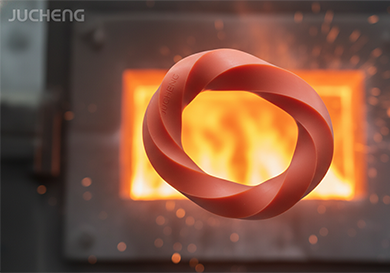
jcproto.com
Silicone’s Heat Secret: Curing Temperature vs. Working Temperature
JUCHENG explores Silicone's thermal management: understanding its decomposition point, optimal curing temperatures, and utilizing its extreme heat resistance for industrial and medical applications.
Sorry, there were no replies found.
Log in to reply.